
The Appeal of Private Credit
The 60/40 portfolio that relies on a 40% allocation to bonds has been an asset allocation staple for decades. This traditional credit allocation provided income and helped to balance a portfolio’s risk profile. The Federal Reserve’s fight to bring inflation under control has raised rates, but has resulted in underperformance in the traditional credit markets. It has also increased volatility in both equity and credit markets. Additionally, we’ve seen the negative correlation between equities and bonds dissipate. With these two markets moving in tandem, the utility of the 60/40 portfolio has been weakened.
Private credit may help investors generate the income they need, while increasing portfolio diversification and helping to maintain an appropriate risk profile.These alternative assets are not traded on public exchanges, so they can carry an illiquidity premium to traditional investments. This also may result in lower correlation to traditional public assets.
Private credit strategies tend to focus on investing in middle market companies, which represent a sizeable investment opportunity. In the U.S., there are nearly 200,000 middle market businesses1.
These businesses are often unable to access the public capital markets, and their funding needs are generally too small to attract large commercial banks. This has led to a rise in asset managers that specialize in lending to these companies.
As the asset class has matured, it has attracted substantial assets and four key components have emerged that underscore the potential benefits of adding private credit to a portfolio.
1. A Yield Premium
Private credit can offer a higher yield than other more liquid assets. As middle market borrowers have less access to large bank funding coupons tend to be higher and offer an illiquidity premium, as the loans are longer-term investments.
2. Diversification
Low correlation with traditional credit asset classes can help to improve portfolio diversification. Private credit has historically had a low correlation to investment grade bonds and the asset class has been generally negatively correlated to U.S. Treasuries.
3. Interest Rate Risk Mitigation
Loans made to private companies typically are floating rate instruments meaning their interest rates adjust as market interest rates rise or fall.
4. Stability in Difficult Markets
Private credit strategies demonstrated resiliency throughout the pandemic. This may be the result of the two features of these types of loans. They are typically senior secured loans and are at the top of a company’s capital stack and they have recourse to the company’s assets in the event of default. The lender also has the ability to add specific covenants on the loan that provide the lender with a degree of control.
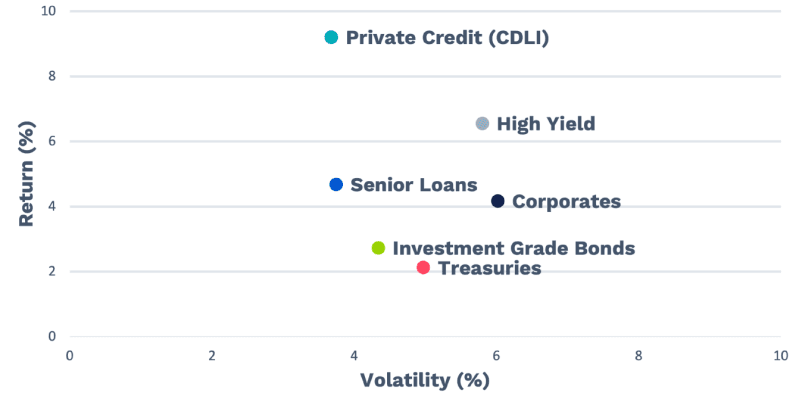
Risk and Return (15 Years Annualized)
Chart compiled by CION Investments. For illustrative purposes only.
Source: ICE BofA Indices, Credit Suisse Leveraged Loan Index, JPM CLOIE Indices, as of June 30, 2023 unless otherwise noted.
As with any asset class, there are certain risks associated with private credit strategies. Credit risk is the risk of non-payment of scheduled interest or principal payments on a debt investment. Because private credit can be a debt investment in non-investment grade borrowers, the risk of default may be greater. Should a borrower fail to make a payment, or default, this may affect the overall return to the lender.
Interest rate risk is another common risk associated with private credit. Interest rate changes will affect the amount of interest paid on a floating rate loan by a borrower meaning they may move in-step with broader interest rate fluctuations. However, this typically has had little impact on the underlying value of floating rate debt. Further, private credit strategies are generally illiquid which require longer investment time horizons than certain other investments. For these and other reasons, this asset class is considered speculative and not appropriate for all investors.
Disclosures
¹National Center for the Middle Market, Mid-Year 2023 report
The information contained within is for educational and information purposes ONLY. It is not intended nor should be considered an invitation, inducement to buy or sell any security or a solicitation to buy or sell any security. The information is not designed to be taken as advice or a recommendation for any specific investment product, strategy, plan feature or other purpose in any jurisdiction, nor is it a commitment from us or any of our subsidiaries to participate in any of the transactions mentioned herein. This is also not intended to be a forecast of future events nor is this a guarantee of any future result. Both past performance and yields are not reliable indicators of current and future results. Information contained herein was obtained from third party sources we believe to be reliable; however this is not to be construed as a guarantee to their accuracy or completeness. Observations and views contained in this report may change at any time without notice and with no obligation to update.
All investments carry a certain degree of risk, including possible loss of principal and there is no assurance that an investment will provide positive performance over any period of time. There are specific risks associated with investing in various types of financial assets and in different countries. The information contained within should not be a person’s sole basis for making an investment decision. One should consult a financial professional before making any investment decision. Investors should ensure that they obtain all available relevant information before making any investment. Financial professionals should consider the suitability of the manger, strategy and program for their clients on an initial and ongoing basis.
CION Securities, LLC, Member FINRA/SIPC.
Want to Download this Article?
DownloadFinancial Professionals, for additional information log in.
Don't have an account?
Register Now
 FP Login