
Dynamic Asset Allocation – Critical for Capturing Today’s Fast-moving Market Dislocations
For decades, investing in credit instruments has been a way to potentially generate income. This has been historically achievable by determining an investor’s risk profile, then maintaining an asset allocation to investment grade fixed income by tracking an index. The composition of the assets generally remained static and was only rebalanced to remain in line with the relevant index.
In the current environment, fast-moving markets and increased volatility are creating difficulties for traditional credit investors.
By broadening the set of potential investments to include credits below investment grade, global credit and alternative credit, investors may be able to access higher yields.However, this universe can also be much more sensitive to market dislocation. Investing with an eye towards adding yield while maintaining a given risk profile can be beneficial. However, it requires a new strategy that provides the ability to play both offense and defense with a degree of alacrity.
Dynamic Asset Allocation
An investment philosophy and process that is centered on dynamic allocation can help a manager capture opportunity. It can also provide for an ongoing defensive posture that can position the portfolio to potentially generate return as markets return to normal.
As the timeframe for these opportunities becomes compressed, the ability to shift a credit allocation quickly towards the entry point and then exit to realize any possible gains is important to generating return. This requires a manager with a global footprint, ability to self-originate deals and access to flexible capital that can be deployed rapidly. It also demands expertise to source and evaluate opportunities in conditions that drive all assets down, regardless of the soundness of their fundamentals. Strong credit selection skills are the backbone of a strategy that seeks to capitalize on market-driven opportunities.
The chart below details the spread movement in the high yield markets over approximately the last 20 years. The spread is the difference between the rate of a given security and a risk-free rate, usually a U.S Treasury. The chart shows that the amount of time the dislocation has lasted has been shrinking and the percentage of return has been growing.
High Yield Market Dislocations: The Opportunity Window is Compressing
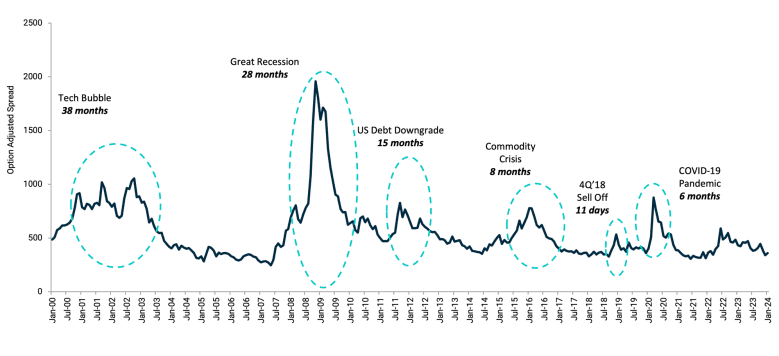
Note: As of January 31, 2024. Represents opinions of Ares’ investment professionals only and should not be construed as investment advice. For illustrative purposes only. (1) Dislocation defined as periods when high yield OAS increased above ~700 before returning to historical median of ~500 Source: The BofA US High Yield Master II Constrained Index (“HUC0”) OAS from January 1, 2001 through January 31, 2024.
An Expanded Opportunity Set
Dynamic allocation demands a broader spectrum of potential investments. A credit portfolio that is constructed to take advantage of relative value opportunities should have the ability to access a diverse range of assets and geographies.
The larger allocations may trim or increase depending on market and economic conditions. The smaller allocations represent the ability to capitalize on inefficiencies caused by temporary market or economic situations, industry or sector driven events, even company or asset-specific situations.
But it’s not just an ability to play offense – dynamic allocation means that the manager can move quickly to position the portfolio to mitigate downside risk as markets evolve.
Hypothetical Dynamic Asset Allocation
The hypothetical allocation above serves to illustrate the potential changes a dynamic allocation can undergo over time. It is not representative of a manager or strategy.
Conclusion
Dynamic allocation is a modern response to seeking yield. Utilizing both traditional and alternative strategies can assist in building a portfolio that stays within risk parameters to potentially generate income and help to mitigate market downturns.
Disclosures
The information contained within is for educational and information purposes ONLY. It is not intended nor should be considered an invitation, inducement to buy or sell a security or a solicitation to buy or sell a security. The information is not designed to be taken as advice or a recommendation for any specific investment product, strategy, plan feature or other purpose in any jurisdiction, nor is it a commitment from us or any of our subsidiaries to participate in any of the transactions mentioned herein. This is also not intended to be a forecast of future events nor is this a guarantee of any future result. Both past performance and yields are not reliable indicators of current and future results. Information contained herein was obtained for third party sources we believe to be reliable; however, this is not to be construed as a guarantee to their accuracy or completeness. Observations and views contained in this piece may change at any time without notice and with no obligation to update.
All investments carry a certain degree of risk, including possible loss of principal and there is no assurance that an investment will provide positive performance over any period of time. There are specific risks associated with investing in various types of financial assets and in different countries. The information contained within should not be a person’s sole basis for making an investment decision. One should consult a financial professional before making any investment decision. Investors should ensure that they obtain all available relevant information before making any investment. Financial professionals should consider the suitability of the manager, strategy and program for their clients on an initial and ongoing basis.
CION Securities, LLC, Member FINRA/SIPC.
Want to Download this Article?
DownloadFinancial Professionals, for additional information log in.
Don't have an account?
Register Now
 FP Login