
What Is Private Credit?
Private credit has experienced rapid growth over the last few years. We look at the history of this asset class and the current state, as well as its utility in investor portfolios.
I Get Private Equity – But What’s Private Credit?
Private credit investing provides a way for businesses to raise capital. In private equity, an investor owns all or part of a company. In private credit, the investor lends money to a company in exchange for interest payments and can impose covenants and/or collateralization that secures the loan. They are called private because unlike with publicly offered company securities, the equity and credit positions are not readily available to the general public.
How Did This Get to Be an Asset Class?
Growth in private credit, like private equity, was originally driven by institutional investors. Institutional investors looking for income in a low-yield post-Global Financial Crisis (GFC) environment realized that the vast landscape of middle market businesses were actively seeking sources of non-bank funding and this helped fuel the rise of private credit as an asset class. Bank consolidation and lending pull-back left these companies underserviced, and to gain access to funding they would pay higher interest rates.
The middle market comprises nearly 200,000 businesses and represents one-third of private-sector GDP. These companies are defined as having $10 million to $1 billion in annual revenue and employ approximately 48 million people.1.
Middle market businesses may be attractive to investors because they can offer diversification across both geographies and industry sectors. They have also shown resilience. During the GFC (2007-2010), these companies added 2.2 million jobs. In 2023, revenues increased for 83% of middle market companies at an average rate of 12.4%, representing two new high marks for the middle market. Middle market companies of all sizes and across nearly all industry segments reported strong growth with most of the growers growing at a rate of 10% or more.1
What’s Happening Now?
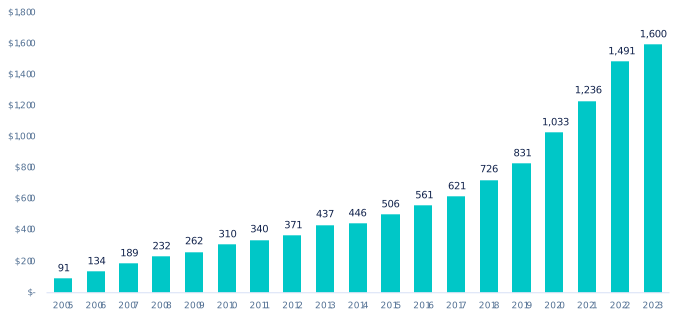
Private credit (sometimes it’s called private debt) has quadrupled in size over the last 10 years and reached $1.6 trillion in assets under management in 2023. The number of managers entering the space has grown, and managers with a history of investing have increased their assets under management.
Private Credit AUM, in billions
Source: Financial Times, Prequin, The Wall Street Journal
What Is Driving the Growth?
Private Credit is considered to be illiquid, and thus may offer an illiquidity premium to investors relative to other more liquid asset classes. Private credits are usually held for long periods or even to maturity – with the expectation that the borrower will pay interest throughout the course of the loan and return the principal to the lender at the end.
Private credit funds may also offer portfolio utility, meaning that these funds may contribute to the portfolio beyond adding return from the underlying investments. Private lenders can focus on senior secured loans, giving the lenders payment priority in the event of a default. They may also deliver additional value by directly influencing pricing and structuring covenants into the terms of their loans.
This can result in more attractive risk-reward characteristics, as they can incorporate enhanced downside mitigants over public debt markets.
What Happens If There’s an Economic Downturn?
In the event of a downturn where banks decrease lending, private debt funds are already well-positioned to offer credit that banks may be unable to. This can help keep businesses going, which may mitigate the severity of a downturn and iron out volatility.
How Can Individual Retail Managers Access These Funds?
A growing number of leaders in credit management have recognized the demand for this asset class and and seek to bring their expertise to retail investors making private credit an option in modern portfolios.
Risks
As with any asset class, there are certain risks associated with private credit. Credit risk is the risk of nonpayment of scheduled interest or principal payments on a debt investment. Because private credit can be debt investments in non-investment-grade borrowers, the risk of default may be greater. Should a borrower fail to make a payment, or default, this may affect the overall return to the lender. Further, private credit investments are generally illiquid which require longer investment time horizons than other investments. For these and other reasons, this asset class is considered speculative and may not be suitable for everyone.
To learn more about Private Credit, please contact your financial professional.
Disclosures
¹National Center for the Middle Market, Year-End 2023 Report.
The information contained within is for educational and information purposes ONLY. It is not intended nor should be considered an invitation, inducement to buy or sell any security or a solicitation to buy or sell any security. The information is not designed to be taken as advice or a recommendation for any specific investment product, strategy, plan feature or other purpose in any jurisdiction, nor is it a commitment from us or any of our subsidiaries to participate in any of the transactions mentioned herein. This is also not intended to be a forecast of future events nor is this a guarantee of any future result. Both past performance and yields are not reliable indicators of current and future results. Information contained herein was obtained from third party sources we believe to be reliable; however this is not to be construed as a guarantee to their accuracy or completeness. Observations and views contained in this report may change at any time without notice and with no obligation to update.
All investments carry a certain degree of risk, including possible loss of principal and there is no assurance that an investment will provide positive performance over any period of time. There are specific risks associated with investing in various types of financial assets and in different countries. The information contained within should not be a person’s sole basis for making an investment decision. One should consult a financial professional before making any investment decision. Investors should ensure that they obtain all available relevant information before making any investment. Financial professionals should consider the suitability of the manger, strategy and program for their clients on an initial and ongoing basis.
CION Securities, LLC, Member FINRA / SIPC.
Want to Download this Article?
DownloadFinancial Professionals, for additional information log in.
Don't have an account?
Register Now
 FP Login